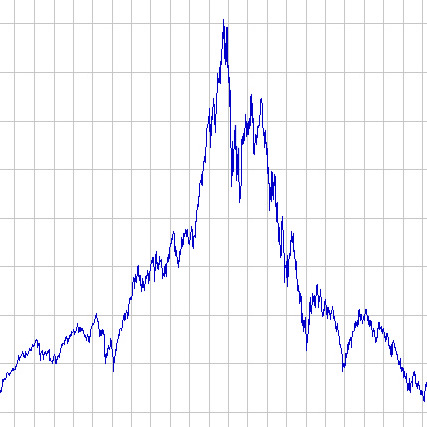
“Market crash”. Just the sound of the phrase makes most
people shudder. But what exactly is a crash, and why do they occur? The
answer lies within human psychology.
People love bull markets. Bull markets have the uncanny
ability to change the collective attitude of society. In a quickly
rising market, even the words of rather prosaic business pundits become
a form of entertainment. This is what happened in the tech boom as Fed
Chairman, Alan Greenspan, became a worshipped celebrity. Eventually the
euphoria changes into downright pessimism as the inevitable market crash
occurs. Later on, the cycle repeats itself. In order to fully understand
these events, we must learn about
behavioral finance.
In financial markets, the “majority is always wrong.”
When the investing majority or the crowd is overly bearish, this is the
best time to be buying stocks. When the crowd is overly exuberant, this
is the time to be selling stocks. The financial markets work in this
ironic way because not everyone can win in the market. If it were
possible for everyone to win in the markets, this would mean that money
is being created from nothing. The creation of money, in this manner, is
impossible. Therefore the markets are a zero-sum game. Zero-sum means
that for every winner, there is a loser. The winner takes the losers
money. Zero-sum games are games where the amount of "winnable goods" is
fixed.
The Start of a Bull Market
The bottom of the market starts at a time when the stock
market is weak and the general population is pessimistic. At this point
most investors sell after having endured a long and torturous bear
market. This extreme pessimism found at a bottom is always irrational
and undeserved. Now the market is
undervalued and is a bargain. Savvy investors, the
“smart money”, buy bargain stocks knowing that they will be able to
sell them higher in the near future. Smart money buying, called
accumulation, causes stocks to rise. The smart money often consists
of NYSE specialists, Nasdaq Market Makers, hedge fund traders and
corporate insiders. These traders have access to information that the
general public does not.
Rising stocks eventually gain the respect of mutual
funds, as billions of dollars of capital is introduced into the market
place. Mutual fund investment causes the stock market to advance in a
powerful manner. Much of the steady large trends are powered by mutual
funds and other institutional investors. After the stock market has
gained, stocks are now fairly valued and are no longer considered
bargains. The smart money is now sitting on a large profit, as well. The
average investor is still skeptical, however.
As bull market events unfold,
retail investors begin to take interest in stocks. Retail investors,
or the unsophisticated little guy, make up the vast majority of
investors. This group does not invest for a living. Retail investors
often make investment decisions based on what they read in financial
magazines, from their brokers and from tips from friends. As the flood
of retail capital is invested, the market soars, causing great euphoria.
At this point in the cycle, many companies become public, or launch an
IPO. Companies go public when
investor sentiment is most optimistic so as to gain the highest
possible stock price. IPO’s generate even more optimism as
unsophisticated investors buy into the fallacious thoughts of instant
riches. Now is the time when many small investors become wealthy. In
this phase, stocks are doubling and tripling as the media cheers on the
advancing bull market.
At this point, the smart money sells, or
distributes, the now
overvalued stocks to overconfident retail investors. The smart money
knows that overvalued stocks are no longer worthy investments, and will
soon drop in value. Widespread greed always occurs, in some form, at
stock market tops. Sometimes this greed takes form as accounting fraud
where companies over inflate their values. Other times companies make
unrealistic promises, such as dot com stocks without any earnings. These
immoral activities can take place because irrational retail investors
will buy a stock simply because it is glamorous. To compound the
problems, investors will now start to use margin, or leverage, to
further accelerate gains. All caution is thrown to the wind as investors
think “the old rules don’t apply”.
The Start of a Bear Market
After mutual funds and retail investors are fully
invested, the market is overbought. This means that there is no more
cash to fuel the rally. The market can only go in one direction: down.
All it takes is just a hint of negative news and the market collapses
under its own weight. Investors quickly realize the market is made of
smoke and mirrors, as frauds or other abuses come to light.
When panic selling starts, a market will always fall
quicker than it had risen. Oftentimes, as everyone heads for the exit at
the same time, there isn’t anyone willing to buy the stock. This can be
especially disastrous for
margin users as they grow deeply indebted to their brokers.
Bankruptcy is the usual result for these foolish gamblers. The
majority of retail investors don’t sell even as the market is
plummeting. This crowd keeps holding on to stocks in hopes that the
market will recover. As the market plummets 25%, then 50% the average
retail investor foolishly holds on, in complete denial that the bull
market is over. Finally retail investors sell every stock they own
plummeting the market even further. This mass exodus is called
capitulation.
The Cycle Starts Again
It is at this point that stocks are undervalued once
again. The smart money is accumulating and stocks rise. The majority of
retail investors bought at the top and sold at the very bottom. This is
the very essence of the
“dumb money”. They are perpetually late into the game. This cycle
continues over and over. Only the smart money actually “buys low and
sells high”. After trading in this manner, the dumb money will adhere to
adages such as, “the stock market is risky”. In reality, however, the
stock market is only risky if you trade like the mindless majority!